
If I had the time assurance that you’d understand and giggle with me – I’d have to change this graphic to read – The Outdoor MONTH Long Obsession . . . . .
It started with realizing that I had never been challenged to learn bird songs before. So I got all dressed up in my finest flannel pj’s and blankets and coats, went out on the balcony, and sat. For almost 2 hours. Listening to the orchestra, without child or pup, was thrilling. The birds work together in concert – air traffic controllers, vacant field regulators, dinner bells – everyone signaling together. Two or three birds of each species worked together, and then worked in harmony with those in the space – or not so harmoniously . . . . The air would only ring with silence with the eaglets soared over. I took my obsession online to listen to the calls – and then to the library to check out cd’s – and then to my family as I continuously shushed them and the dog stayed inside.
Spring birds are returning to our yard – only this is the first year for us – and with the lake so close – these are birds we have never seen, outside of print – and some not even noticed on the page yet.
It has taken weeks to gather all of the information – and then narrow down my scope – and my expectations of the boys learning every tiny chirp – to conduct an Actual Outdoor Hour Study. 🙂
Last week the boys and I went out on the balcony for timed 15 minutes. By this time they have been listening to the birds with me all month, and could name quite a few, or know of the warning blasts, happy eating chirps, and the Come Home calls. The “study” part sort of went down hill when the Frisbee came out with the warm sun, and I spied some weeds (sorry Barb) flowers growing where I didn’t intend – and the journaling part was lost to a 2 minute effort of scribbling out the notebooking page and running off to do the next thing.
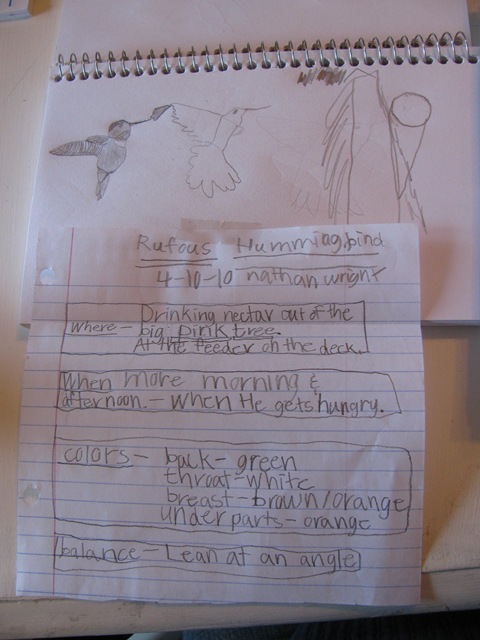
Yesterday – we sat and talked of our favorite birds – narrowed down to the Rufous Humming Bird and the Tree Swallow. Of course each boy wanted to study a different bird . . . . but we agreed on the Rufous Hummingbird for our intentional study.
Reading from the Handbook of Nature Study – we learned that they probe the flowers – for both nectar and insects – and heard the description of what we had seen, of the momma training her children. Comstock describes it as the momma showing the little ones what to do, the little ones probing a dead flower or branch, and then mamma taking them away for a time to come back a bit later. I hate to get all “pondering” over at the school page – but it reminds me of training the boys in the supermarket of whining or begging, leaving the store, coming back to try again. Made me wonder what other things we should just “show them the most beneficial way”, let them make a mistake, and leave to try again . . . sorry – back on track –
We have seen the baby humming bird You Tube videos and pics – but did read for the first time that the nest is seldom larger than 3/4 of an inch in diameter. Amazing.
We’ll study the Tree Swallow this week – have already gathered interesting facts – and we WILL be doing the Apple Study – as we ran into an Apple Orchard Restoration Fellah this week. . . . Pebbles in the Path!
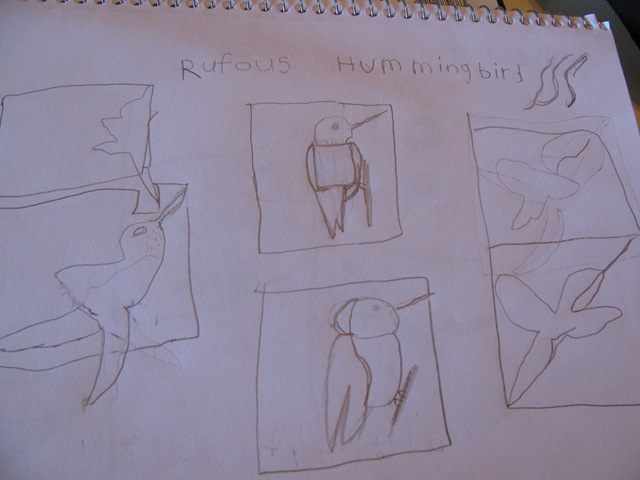
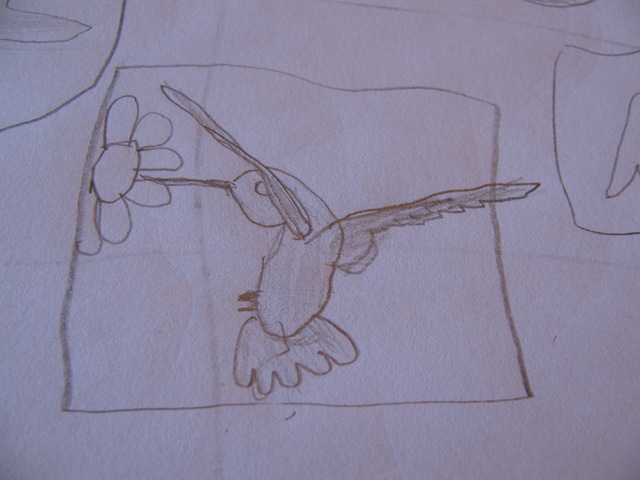
Here are some of the journaling – I’m not sure where the original notebooking pages ended up.
Oh – and here is a link to the Birds of Lincoln County I have been collecting. I post almost daily now to the album – It is on Picassa – CLICK HERE To VIEW .
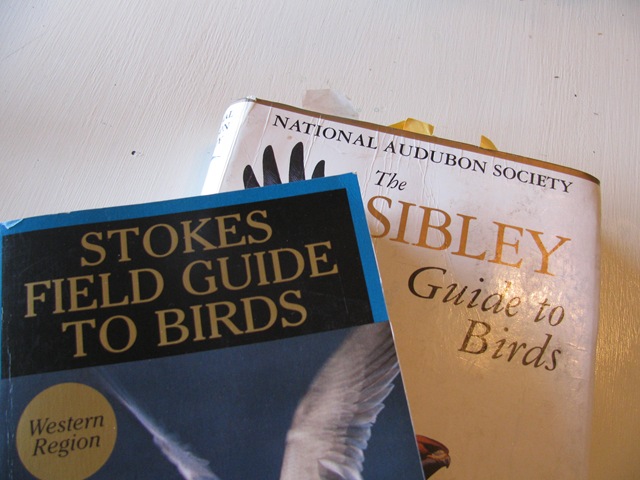 I am not really pleased with either of these books – we started with the Sibley – but the hand drawn photos often do not reflect the colors we are seeing – do you have a favorite all around North American book? We’d heard about one with migration patterns in it as well, but have not been able to locate it. We just check out 5-10 books at the library every other week on birds. 🙂
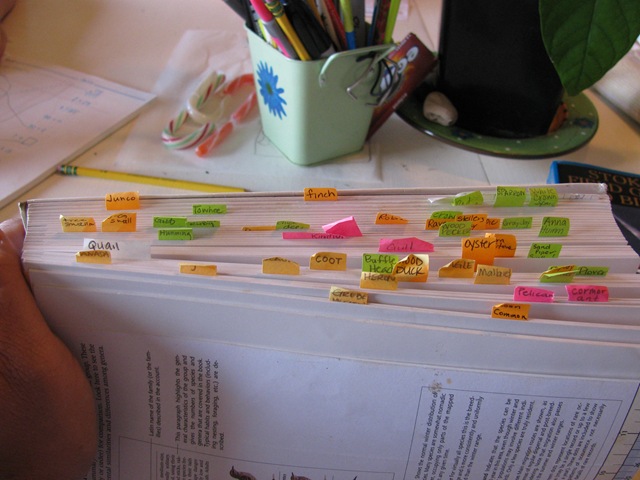
I set tabs on each bird listed in Devils Lake Area – 6 months ago they were all at the top of the book waiting to be found – now I am down to 3-4 ducks that we have not seen yet to identify! Amazing!
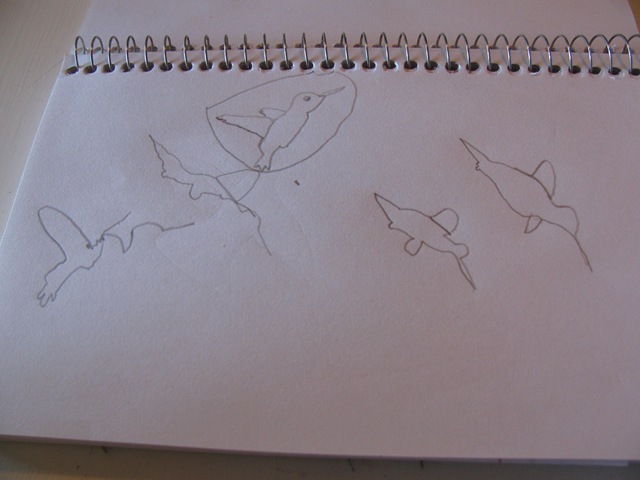
Learning Sketch Drawing from Claire Leslie Walker – We begin with a Blind Contour Drawing of the bird. Looking only at the field guide, tracing the bird with our eyes – not looking at our hand – it is the perfect way to adjust your left/right brain function as well as seeing the details of what is THERE and not what you WANT to draw. It is easy to see if a student is being honest with the Blind Contoured Drawing, if they come up with an elementary drawn bird or a bunch of lines. 🙂 Sometimes, if they really pay attention, the blind contour drawing is better than the visual one! We moved on to a Visual contour drawing, still looking at the book, but also glancing at the paper, focusing on the contour of the bird. Then spending time with shapes, defining the shape of the head, body, wing, angle, size. Then –on to drawing free style of sorts 🙂



 +Angie Wright









 Pebblekeeper
I would love to do this type of nature study…I’ve tried but we live in the city (UGH) and don’t really have many places to go for a nature study…
Delightful! You inspire me!
I think alot of my “hare” tendencies comes from the newness of it all – of really seeing details instead of “outside” as all being grouped into “outside”. Also – our quick focus here – is that we may be transferred soon – so taking the time to see the big picture, as much as we can, before we move. 🙂 We may be here one more year – and then I’ll slam on the breaks of studying EVERYTHING quickly. 🙂
We have such different styles to our learning…I’m more of the tortoise and you are more the hare. I have been at this bird challenge for about 5 years and just now feel like I am comfortable with definitely identifying our local birds by sight and now we are working on by call or song. I get overwhelmed and it is so much easier for me to take a few at a time.
We like the Peterson Field Guides the best…they have a book that I especially like for learning more systematically about birds called Finding Your Wings. You might look for that one. It is more than a “workbook”…much better.
For now I am content to spot a red-tail and a red-shouldered hawk and spot the differences. We have heard both lately and I want to see them better with my binocs.
Thanks for sharing your month long study…terrific stuff. You are a great example to your boys.