
We are so thrilled that early in our homeschooling, several families told us about Miquon Math. Both of my boys have used this program through the 4th or 5th grade. Nathan, who is now 11 did Miquon, then jumped to Saxon 6/5, and is now half way though Saxon 7/6. Jon who has just turned 9 is starting the Yellow Miquon book tomorrow.

Miquon, like Math U See, uses rods for measurement. However, the rods differ a bit. Cuisenaire Rods have 10 to a set with white measuring one centimeter and orange measuring 10 cm. There are packs that include the 100 and 1000 blocks that can be purchased separately. Along with the rods, we enjoy using a track.
With the track 3×5 becomes a sentence with a puzzle. What is 3 of the 5’s. So easily the boys pick up 3 of the yellow rods and places them on the track to instantly see that three of 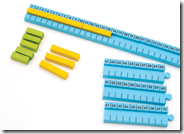 the fives puts you at 15. 3×5=15. So they can touch, feel, see, write, think.
Each boy knows their multiplication facts, without drill work. Like in Math U See, they are encouraged never to guess at an answer, but to use the rods to figure out the answer. 2/3’s of 6 – we spilt six into three equal parts, then find two of the parts. So six can be split three times with three red rods, two of the red rods equals 4.
The lab sheets helps the parent to know what the point of the sheet is. I have found that engineering dads and math whiz moms put a little too much college math into figuring it out. Math time should be a fun time of puzzles, like legos picture puzzles. Find the pieces that demonstrate the sentence. Learning how to say the sentence, and understanding what the sentence means, leads to the answer. i.e. 2 of the 3 parts of the 6 – I have 6 cookies and 3 friends, how many will each receive equally? How many will two friends have?
Now that we are done with Miquon with our oldest son, we switched to Saxon 6/5. Saxon is teaching us more of the vocabulary of math, numerators and denominators, how to divide 2/3 by 6/1 correctly on paper. We have found that the vocabulary change had been the larger learning curve last year, than learning a harder level of math. Now, this year, at Saxon 7/6, we are learning more details of decimals/fractions/percents that were not covered in Miquon, and we are finding the moving through the book is going at a slower pace.
My advice for Miquon – is to start at the beginning and move through each book. If you are reading this with a Second Grade Homeschooler, go ahead and purchase the first two books and work through them quickly, seeing what areas need to be discovered. Each book is separated in skills labeled with the alphabet. So you could tear out all of the A sections of both books, and then do A in the 3rd book. Again, teaching them to understand the question asked is key.
We are thinking of moving to Teaching Textbooks next year. We use the DIVE CD for 7/6 an it has been WONDERFUL at explaining details of the “how to”.
Did you use Miquon? What did you use after Miquon? Have you switched from Saxon to Teaching Textbooks? Why? What did you find?
If you are struggling with a part of Miquon, I love answering questions, so feel free to email or comment for everyone to see.


 +Angie Wright